This is a video excerpt featuring Russell Barkley, Ph.D. from his day long video lecture entitled “Optimizing ADHD Treatment: The Impact of Co-Occurring Disorders”. For details on the full video and to order, please visit the CMI Education Institute’s website at www.pesi.com.
watch part one!
sources:
/
3
n
s
s
trials: 3
Back cracking video: />
Looking for books and want to support me and indie bookshops? Use my affiliate link! n
The Transgender Issue: 1
Use this link to get £10 off your first yfood order: F
Sign up to Cash App using my code and we will both get £5: QQRXXVZN
Music by Naomi - Osaka -
Email: ArtieCardenBusiness@gmail.com
Support me on ko-fi: n
Honey referral joinhoney.com/ref/bz6gr3s
I get 500 points with each sign up and qualifying purchase
Biomel referral: Z
Red Bubble: n
Try out canva with my link: n
~ please like and subscribe ~
Follow my blog!
follow my instagram: /
follow my Twitch: n
follow my twitter: _
follow my pinterest:
like my Facebook: /
Zine Issuu:
You Now:
Ao3: n
My ADHD days are challenging and sometimes awkward. Often it involes being late. But, that stopped with the simple tips I share towards the end of the video. (This isn't a trick to keep you watching, it's just, everything before that is much funnier.) Ha.
This ADHD VLOG is all about the Comedy and humor in ADHD. It's also about solutions, just like the flagship show, ADHD is the new Black...only more casual and less labor-intensive.
My mission with ADHD is the new BLACK? To embrace Neurodiversity and creae a space for us that honors us...BLACK WOMEN AND WOC. Here's to honoring you, your perspective and experience of being a Black Woman or WOC with ADHD.
If you recognize yourself in my "oops" moments, then LIKE, SUBSCRIBE, leave a comment, make yourself known! And for the love of Adderall, SHARE this video with someone who needs a hug from others who "gets" them. You are not alone in your challanges and more importantly, no matter where you are on your ADHD journey, YOU ARE more than OKAY!!!
I SEE you. l LOVE you!
Nicole shares her ADHD story with us. She has an entertaining story of how she first realized she has ADHD. Nicole shares a lot with us in the conversation. You will hear how she views the role that ADHD plays in her life, she reads a letter she wrote to her ADHD, and she describes the changes she is experiencing in her life now because of her involvement in the ADHD reWired Coaching and Accountability Group.
The shownotes for this episode are at 0
Learn more about the ADHD reWired Coaching & Accountability Group at m
My recent TED Talk got picked up on Facebook and renamed "This is is what it's really like to have ADHD," but that was just my story. ADHD isn't just one story – it's the stories of thousands of people around the world. It's the stories of children, of college students, of adult adhd. It's more than their symptoms: it's the story of their struggles and their successes.
These are some of those stories.
If this message means something to you, please share.
This is a video excerpt featuring Russell Barkley, Ph.D. from his day long video lecture entitled “Optimizing ADHD Treatment: The Impact of Co-Occurring Disorders”. For details on the full video and to order, please visit the CMI Education Institute’s website at www.pesi.com.
Social anxiety disorder (SAD), also known as social phobia, is an anxiety disorder characterized by sentiments of fear and anxiety in social situations, causing considerable distress and impaired ability to function in at least some aspects of daily life.[2]: 15 These fears can be triggered by perceived or actual scrutiny from others. Individuals with social anxiety disorder fear negative evaluations from other people.
Physical symptoms often include excessive blushing, excess sweating, trembling, palpitations, and nausea. Stammering may be present, along with rapid speech. Panic attacks can also occur under intense fear and discomfort. Some sufferers may use alcohol or other drugs to reduce fears and inhibitions at social events. It is common for sufferers of social phobia to self-medicate in this fashion, especially if they are undiagnosed, untreated, or both; this can lead to alcohol use disorder, eating disorders or other kinds of substance use disorders. SAD is sometimes referred to as an illness of lost opportunities where "individuals make major life choices to accommodate their illness".[3][4] According to ICD-10 guidelines, the main diagnostic criteria of social phobia are fear of being the focus of attention, or fear of behaving in a way that will be embarrassing or humiliating, avoidance and anxiety symptoms.[5] Standardized rating scales can be used to screen for social anxiety disorder and measure the severity of anxiety.
The first line of treatment for social anxiety disorder is cognitive behavioral therapy (CBT).[6] Medications such as SSRIs are effective for social phobia, especially paroxetine.[7] CBT is effective in treating this disorder, whether delivered individually or in a group setting.[8] The cognitive and behavioral components seek to change thought patterns and physical reactions to anxiety-inducing situations. The attention given to social anxiety disorder has significantly increased since 1999 with the approval and marketing of drugs for its treatment. Prescribed medications include several classes of antidepressants: selective serotonin reuptake inhibitors (SSRIs), serotonin-norepinephrine reuptake inhibitors (SNRIs), and monoamine oxidase inhibitors (MAOIs).[9] Other commonly used medications include beta blockers and benzodiazepines.
ADHD reWired with Eric Tivers Renowned professor, educator, and author of numerous ADHD books and clinical manuals, Dr. Russell Barkley talks about the mechanics and ideas behind many core ADHD concepts. Ranging from executive functions, to neuroimaging, to public perception and more, Dr. Barkley shares knowledge from his extensive research and informed perspective on ADHD, breaking down its basic concepts in an understandable and approachable way.
Nicole shares her ADHD story with us. She shares a funny story about how she discovered she had ADHD. In the conversation, Nicole shares many things with us. She will share her thoughts on ADHD and read a letter to her ADHD. Then she will describe the changes in her life as a result of being in the ADHD ReWired Coaching and Accountability Group.
This episode’s shownotes are located at 0
Find out more about ADHD reWired Coaching & Accountability Group on m
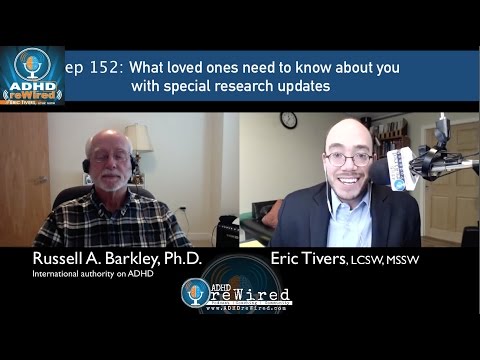
Joining me for this week’s episode is Russell Barkley, Ph.D. Dr. Barkley is a clinical professor of psychiatry at the Medical University of South Carolina. He is a clinical scientist, educator, and practitioner who has published 23 books, rating scales, and clinical manuals. He has also published over 270 scientific articles and book chapters related to the nature of assessment and treatment of ADHD and related disorders.
This conversation will feature Dr. Barkley discussing his new book, “When an Adult You Love Has ADHD”.
This opens up a discussion about attachment and relationships with ADHD patients. Russell discusses the second part of the conversation and shares some of the latest findings regarding gender in ADHD, adult-onset, neuroimaging genetics, environmental factors and psychosocial treatment.
Connect with Russell Barkley:
Buy Russell Barkley’s new book: 2
Use my Audible.com affiliate link for your favorite titles: d
ADHD reWired Coaching and Accountability Group You can save $450 by registering now for one of our spring sessions for the ADHD reWired Coaching and Accountability Group. Early registration ends on January 31st. Go to and schedule a call if you want to join.
Productivity Q&A Live answers to your ADHD questions! These will continue in 2017 on the 2nd Tuesday of every month at 12: 30 PM CST. Visit.
ADHD Women’s Palooza ADHD is more common in women than it is in men. The 2nd Annual ADHD Women’s Palooza will be happening February 6th-11th. This is a free event and you can register at a
ADHD report: d
Website – g
These time stamps may differ slightly from the ones shown in this video. These times are based upon the times as heard in the podcast. They may differ slightly from the ones shown here. You can ALL of them at www.erictivers.com/152. The summary was too long so I had to cut it. You can find more information on the website.
[07:13] – Dr. Barkley explains the reasons he wrote When an Adult You Love has ADHD.
[09:42] Dr. Barkley discusses how family members can create a safety net that doesn’t enable.
[12:19] Russell Barkley discusses being an expert on ADHD and the difficulties of having family members with this diagnosis.
[15:03] Russell Barkley discusses James Prochaska’s research and the willingness of patients to participate in the process of change. Russell outlines the stages.
[20:00] Russell Barkley answers a question about a person who is in a relationship that has ADHD symptoms. He will not test or suggest different strategies. He discusses how to deal with these situations.
[28:45] Tiffany asks Dr. Barkley a question. She addresses the question of how ADHD affects attachment and relationships. Russell also discusses some of the danger areas in which women with ADHD are found.
[34:23] Dr. Barkley discusses recent findings regarding ADHD in women and shares his views on gender and ADHD.
[39:44] Russell Barkley discusses adult-onset ADHD. He says that self-reports can be unreliable and inaccurate.
[51:36] Russell Barkley offers some thoughts about the importance of accountability for people with ADHD.
[57:45] Russell Barkley discusses some recent research he has done.
[1:02:23] Dr. Barkley believes that we are only 2-5 years away from diagnosing ADHD cases with neuroimaging.
[1:04:40] Dr. Barkley discusses advances in ADHD genetics.
[1:08:55] Dr. Barkley discusses the role of environment factors in ADHD’s ideology.
[1:10:42] Dr. Barkley discusses some recent developments in psychosocial treatment.
Visit m This episode can be found at www.erictivers.com/152
ADHD reWired with Eric Tivers Renowned professor, educator, and author of numerous ADHD books and clinical manuals, Dr. Russell Barkley talks about the mechanics and ideas behind many core ADHD concepts. Dr. Barkley’s knowledge and insight on ADHD covers everything from executive functions to neuroimaging to public perception, and many other topics.