Pages

Showing posts with label dexamphetamine. Show all posts

Saturday, September 3, 2022

How ADHD Affects Your Brain | Harold Koplewicz | Big Think

featured image

How ADHD Affects Your Brain
New videos DAILY: k
Big Think Edge offers exclusive video lessons by top thinkers and doers. e
———————————————————————————-
Koplewicz says Attention-Deficit hyperactivity Disorder (ADHD) is real. The frontal lobes, cerebellums and brains of ADHD patients are markedly different from those who don’t have it.
———————————————————————————-
HAROLD KOPLEWICZ

Dr. Harold Koplewicz, a nationally recognized child and adolescent psychiatrist, is a leading figure in the field. He is a pioneer in the field, a champion for child mental health, as well as a skilled clinician. He is also a pioneer in public education to dispel myths and stigma around children and adolescents with psychiatric disorders. Koplewicz was repeatedly named in America’s Top Doctors and Best Doctors in America. He also received New York Magazine’s “Best Doctors” award. In 2006,, he was elected Director of the Nathan S. Kline Institute for Psychiatric Research. This is the third time that Koplewicz held this position since its founding in 1952.. He is also the founder of the Child Mind Institute.
———————————————————————————-
TRANSCRIPT:

Question: Is there a difference between a normal brain and one with ADHD or not?

Harold Koplewicz: So Attention Deficit/Hyperactivity Disorder is a very misunderstood psychiatric disorder. It’s real. This disorder affects between five and eight percent of the world’s population. It’s not a normal condition. You have children who are more hyperactive and impulsive than others their developmental age. It is a lifetime disorder. This means that the symptoms may look different between children of different ages, such as a preschooler, school-age child, high school student, or adult. However, there is always a consistent pattern of hyperactivity, inattention, and impulsivity.

In fact, hyperactivity often disappears with age. This symptom disappears when someone is in their late teens or early adulthood. If we can look at ADHD children’s brains, it is clear that they are different from other children. And in fact, an important study was done about 15 years ago that followed kids over a decade who had Attention Deficit/Hyperactivity Disorder, and these were children who had never taken medication. These were children who had met the diagnostic criteria and who were examined at the National Institute of Mental Health. Their parents said that they would never give Ritalin to their kids. They were then compared with a group of normal or typical children of the same age. They found significant differences in the cerebellum and the frontal lobe.

Your executive function is located in the frontal lobe. This is where you can prioritize which items to tackle first. What is the most important thing I need to do today? How can I do that before I tackle item 2, 3, 4, or 5 that are challenging me…as far as my daily tasks go.

The cerebellum is the place where coordination takes place. It’s interesting to note that these children grew up and reached adolescence. This would explain why hyperactivity symptoms seemed to decrease and the frontal lobe appeared smaller than normal.

Question: What are the effects of these drugs on brain imbalances?

Harold Koplewicz – I believe it is important to recognize that our brains are full of neurotransmitters. These brain chemicals move between brain parts and exchange messages.

Dopamine, serotonin, and norepinephrine are the three major neurotransmitters. And when you have Attention Deficit/Hyperactivity Disorder, you use your dopamine and your norepinephrine faster in your brain than the average person. You may become less attentive, impulsive, or hyperactive if you don’t get enough.

ADHD patients with ADHD have smaller brain centers. These centers are rich in dopamine, and norepinephrine. It’s nice to know that there is a neuroanatomical reason to ensure that all chemicals are equal.

You can’t take serotonin, norepinephrine, or dopamine and get it to the brain. This is because the blood/brain barrier protects the brain, spinal cord and neurotransmitters. These brain chemicals move in that space. …

Please visit n to view the complete transcript.


https://medbusiness.net/how-adhd-affects-your-brain-harold-koplewicz-big-think/

A ten minute guided meditation designed to release your anxiety, stress, and overthinking.

Sunday, August 21, 2022

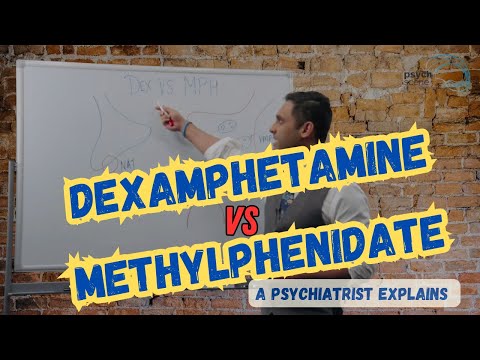
Difference between DEXAMPHETAMINE & METHYLPHENIDATE in ADHD | ADDERALL | RITALIN | DR REGE EXPLAINS

featured image

DEXAMPHETAMINE and METHYLPHENIDATE are medications used to treat Attention-deficit Hyperactivity Disorder (ADHD).
Dr Rege, Consultant Psychoiatrist, explains the differences.
#adhd #adderall #ritalin #vyvanse #dexamphetamine #methylphenidate #amfetamine

Methylphenidate (MPH)
Mechanism of Action:
Non-competitively, Methylphenidate blocks the reuptake dopamine/noradrenaline into terminals by blocking dopamine transporter and noradrenalinetransporter (NAT). This increases levels of dopamine/noradrenaline within the synaptic cortex.

Amphetamine can be classified as a d and l-isomer.
The active isomer is the d-isomer.
Mechanisms of Action :
1. Competing with noradrenaline and dopamine at NAT, competitive inhibitor at DAT
2. VMAT
Competitive inhibitor3. Reversal of DAT.

Music by:
Song: Clarx – Shakedown [NCS release ]
].Music provided by NoCopyrightSounds
Download/Stream Free: n
You can watch: g


https://bestanxietycrystals.com/difference-between-dexamphetamine-methylphenidate-in-adhd-adderall-ritalin-dr-rege-explains/

Do you know anyone who has been diagnosed with both Autism and ADHD? Eric and Becca, his guest, discuss their diagnosis and how ADHD manifests differently in women. They also discuss why they are interested in conscientiousness research in this area.

Becca is earning her master's degree in Industrial-Organizational Psychology and hopes to use her knowledge in individual differences, such as ADHD in personality and training in Industrial-Organizational Psychology, to help organizations create inclusive work environments for employees.

Becca discredits the idea that people with ADHD and Autism aren't conscientious. She discusses her understanding of Autism, how it manifests for her, as well as how it has affected her life. Eric talks about the differences between Autism and Aspergers, and the arguments surrounding them.

Becca talks about ADHD and how conscientiousness and gender affect ADHD. She also discusses her withdrawal from people due to her daily struggles. This is what led her into seeking a diagnosis. She discusses her sensory challenges and the constant struggle to be on-time.

Social communication is an executive social function. Eric and Becca talk about the fact that women have a social wiring to reflect their environment. They also discuss how Becca interacts with others. Eric asks Eric a hypothetical question about whether a blue pill or a red pill would cure ADHD. Would you consider it?

Becca has shared her struggles with ADHD and Autism. Some of these are embarrassing while others can be frustrating. Becca hopes to share her struggles with Autism and ADHD, so that others can benefit from them. This conversation will help you to look at yourself and think, "Hmmm."

You'll learn:

[02: 32] Becca, welcome to the podcast! [03: 01] Becca shares her diagnoses of Autism and ADHD. [06: 46] She challenges the statement that people with Autism are not high in conscientiousness. [09: 03] Eric shares the definition of conscientiousness. [10: 03] Becca questions whether people with ADHD are low in conscientiousness. [12: 00] Have you been told you can't be on the spectrum because you are so smart? [13: 14] Eric says that it is essential to understand that we are all different in the way we show up. [13: 37] What got you interested in studying consciousness in this realm? [15: 34] Becca shares her understanding of Autism and how it shows up for her. [18: 02] Becca speaks about having a case manager come to talk to her and her mom and ask if she could use a spoon and fork. [19: 45] Eric chats about the difference between Autism and Aspergers and the argument around both. [26: 02] Becca speaks about how gender and conscientiousness change the manifestation of ADHD. [28: 44] Have you felt shame or guilt because you forgot to go to the store or didn't have dinner? [30: 18] Becca speaks about withdrawing from others because she struggles to manage her everyday life. [32: 00] Becca shares a story about what led to her diagnosis of ADHD. [33: 03] Becca chats about the struggle to be on time when she goes somewhere. [34: 37] What is the hardest part for you of having ADHD? [36: 34] Becca speaks about having sensory challenges and what it is like for her. [38: 38] Did you know that social communication is an executive social function? [40: 20] Eric speaks about some studies that show women are more socially wired to mirror their environment. [47: 32] Becca shares how she works through social interaction in her brain. [49: 30] Do you show empathy differently from people around you? [51: 18] Becca speaks about smiling and laughing at funerals when everyone else is crying. She is not happy because she can't control her happiness. [53: 32] Eric chats about teaching micro-expressions and training. [56: 02] Are you different but not less? Are you aware of your strengths and weaknesses? [58: 16] Eric speaks about the hypothetical question about if you could take a pill to make your ADHD go away would you take it? [1: 00: 52] Is there anything you want to say to the listeners? [1: 01: 03] Becca, thank you so much for sharing your story! [1: 01: 18] If you are wondering if you have Autism or ADHD, find a specialist. [1: 02: 36] If you are a regular listener, consider becoming a patron and on our Patreon at www.ADHDreWired.com

Saturday, August 13, 2022

Difference between DEXAMPHETAMINE & METHYLPHENIDATE in ADHD | ADDERALL | RITALIN | DR REGE EXPLAINS

featured image

DEXAMPHETAMINE and METHYLPHENIDATE are medications used to treat Attention-deficit Hyperactivity Disorder (ADHD).
Dr Rege, Consultant Psychoiatrist, explains the differences.
#adhd #adderall #ritalin #vyvanse #dexamphetamine #methylphenidate #amfetamine

Methylphenidate (MPH)
Mechanism of Action:
Non-competitive blockage of dopamine reuptake by Methylphenidate, MPH (MPH), occurs when dopamine transporter is (DAT) or noradrenalinetransporter (NAT) are blocked. This results in increased levels of dopamine (and noradrenaline) in the synaptic cell cleft.

Amphetamine can be classified as a d and l-isomer.
The active isomer is the d-isomer.
Mechanisms of Action :
1. Competing with noradrenaline and dopamine at NAT, competitive inhibitor at DAT
2. VMAT
Competitive inhibitor3. Reversal of DAT.

Music by :
Song: Clarx – Shakedown [NCS release ]
].Music provided by NoCopyrightSounds
Free Download/Stream:
You can watch: g


https://bestanxietycrystals.com/difference-between-dexamphetamine-methylphenidate-in-adhd-adderall-ritalin-dr-rege-explains/

The ADHD Planner - Undated Daily Weekly Schedule Organizer Journal for Disorganized People - Habit Tracker Record Emotions & Mood - Academic Goals - Structure & Focus for Adults Brains (Spiral) (Red)

Product Description Undated ✓ ✓ ✓ ✓ ✓ ✓ Habit Tracker ✓ ✓ ✓ ✓ ✓ ✓ Academic Goals ✓ ✓ ✓ ✓ ✓ Password Manager No No No No ✓ ✓ Weekly Reflectio...