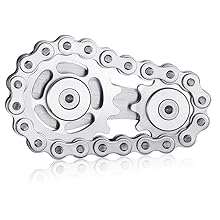
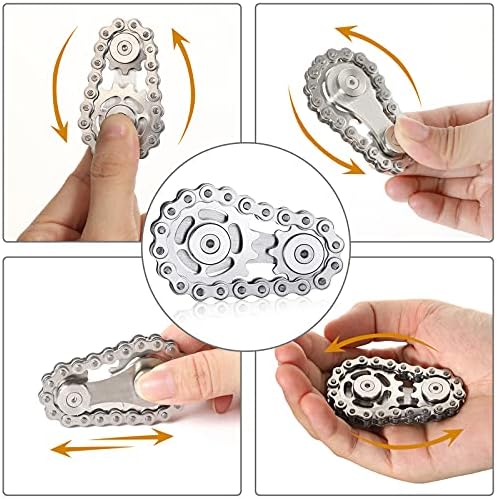
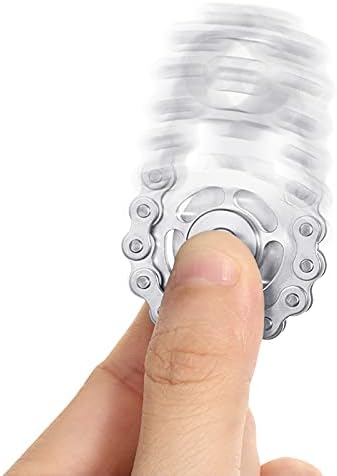
★【UNIQUE DESIGN】 — This sprockets chain fidget toy is the most unique designed fidgeting toy ever for anxiety toys for adults , based on bike chains spinning toy design, which gives you various ways of fidgeting to help concentrate, reduce stress, and release your inner creativity and imagination. It helps to avoid bad habits, such…
Click Buy Now for Updated Price. Estimated Price: 23.98$
★【UNIQUE DESIGN】 — This sprockets chain fidget toy is the most unique designed fidgeting toy ever for anxiety toys for adults , based on bike chains spinning toy design, which gives you various ways of fidgeting to help concentrate, reduce stress, and release your inner creativity and imagination. It helps to avoid bad habits, such as nail biting and smoking, autism and anxiety disorders, and other irritability problems. ★【DURABLE】 — Full Stainless Steel Construction, Precision machining parts make this fidgets toy not easy to damage. 2 silent bearings are used in this hand spinner to bring you ultra-smooth spinning experiences and long time durable usage. ★ 【KILLER OF ANXIETY】 — Great Fidgeting toy for releasing anxiety, relaxing, staying awake, ADHD, ADD, autism and other attention disorder issues. Helps you calm down while stressful and brings creative ideas with deep thinking,kills your time when gets bored. ★ 【PERFECT GIFT CHOICE】 — Suitable for Adults and Kids over 12 years old and the beautiful packaging included makes our fidget spinner the ideal gift for your friends ,collegues, kids and classmakes. Gifts for Adults and Kids, Stress Anxiety ADHD Relief Figits Toy, Metal Finger Hand Spinner Toys. ★ 【100% SATISFACTION】 — If you don’t absolutely LOVE the Sprockets Chain Fidget Toy, Just contact us for a full refund. We will be happy only when you’re happy.
Hello brains! This week’s episode is about why we fidget and how we can use it to our advantage.
THE TOYS:
Critter Puff Stress Balls: n
The Ultimate Fidget: l (get a pack of them at: )
Boink! Fidget Toy: O
The Tangle: E
The Fidgipod: 3
MORE INFORMATION:
Let them fidget: 1
Maintain Focus: p
How fidgets can help: P
CHAPTERS: 00:00 – Topic Intro: Fidgeting! 00:27 – Why Do We Fidget & How It Helps 01:20 – Fidget Toys, What Are They & Fidgeting Responsibly! 02:01 – Fidget Toy Reminders 02:13 – Meet The Fidgets! 03:08 – Video Wrap Up & Outro
“The Show Must Be Go” Kevin MacLeod (incompetech.com) Licensed under Creative Commons: By Attribution 3.0 .
Social Anxiety Disorder is an anxiety disorder characterized by intense feelings of worry and distress in social situations. Do you know how to spot the difference between shyness and social anxiety? It’s very easy to mistake having social anxiety as just being shy. So, here are 8 clear signs you might have social anxiety. We also did a video on differences between shyness and social anxiety before: Q
Also, as a disclaimer, do not use this video to self diagnosed social anxiety. It's best to talk to a professional. However, if you're really looking for help, you can also try online counselling here:
o
o
#socialanxiety #anxiety #psych2go
More videos here:
Social Anxiety - More than Shyness
/>
5 Things About Social Anxiety No One Talks About
/>
5 Signs It's Social Anxiety and not Introversion
/>
5 Ways to Deal with Social Anxiety on Your Own
/>
Credits
Writer: Chloe Avenasa
Script editor: Isadora Ho & Kelly Soong
VO: Amanda Silvera
Animator: Lesly
YouTube Manager: Cindy Cheong
References:
American Psychological Association (2013). Diagnostic and Statistical Manual of Mental Disorders – 5th Edition. Washington, DC; APA Publishing.
Psycom (2017). “Social Anxiety Disorder: Symptoms, Causes, and Treatment.” Retrieved 31 March 2020 from w
National Collaborating Centre for Mental Health (2013). Social Anxiety Disorder: Recognition, Assessment, and Treatment. British Psychological Society, Leicester (UK).
Kocovski, N. L., & Endler, N. S. (2000). Social anxiety, self‐regulation, and fear of negative evaluation. European Journal of Personality, 14(4), 347-358.
Heimberg, R. G., Hofmann, S. G., Liebowitz, M. R., Schneier, F. R., Smits, J. A., Stein, M. B., & Craske, M. G. (2014). Social anxiety disorder in DSM‐5. Depression and Anxiety, 31(6), 472-479.
Davila, J., & Beck, J. G. (2002). Is social anxiety associated with impairment in close relationships? A preliminary investigation. Behavior Therapy, 33(3), 427-446.
Moitra, E., Herbert, J. D., & Forman, E. M. (2008). Behavioral avoidance mediates the relationship between anxiety and depressive symptoms among social anxiety disorder patients. Journal of Anxiety Disorders, 22(7), 1205-1213.
Roth, D., Antony, M. M., & Swinson, R. P. (2001). Interpretations for anxiety symptoms in social phobia. Behaviour Research and Therapy, 39(2), 129-138.
Would you like to become an ambassador and help promote psych2go's content to reach more people? Email us at tai@psych2go.net
Hello brains! This week’s episode is about why we fidget and how we can use it to our advantage.
THE TOYS:
Critter Puff Stress Balls: n
The Ultimate Fidget: l (get a pack of them at: )
Boink! Fidget Toy: O
The Tangle: E
The Fidgipod: 3
MORE INFORMATION:
Let them fidget: 1
Maintain Focus: p
How fidgets can help: P
CHAPTERS: 00: 00 – Topic Intro: Fidgeting! 00: 27 – Why Do We Fidget & How It Helps 01: 20 – Fidget Toys, What Are They & Fidgeting Responsibly! 02: 01 – Fidget Toy Reminders 02: 13 – Meet The Fidgets! 03: 08 – Video Wrap Up & Outro
“The Show Must Be Go” Kevin MacLeod (incompetech.com) Licensed under Creative Commons: By Attribution 3.0 .
Jim Garrett, director of Marketing, offers an early look at the latest Revel Concerta speakers, due on sale this autumn.
Learn more about Revel at /
Find us on Facebook: s
Add us on Google+ : /
About Revel: Science is at the heart of everything we do. While the rest of the industry focuses on shallow aesthetics, our engineers are busy in the lab perfecting the audio accuracy of our products.
Since our very first loudspeaker, we obsessively test and re-test every element so you get the most out of every product. The result is music produced with the utmost purity— music that's played the way the artist intended.
★ 【UNIQUE DESIGN】 — This sprockets chain fidget toy is the most unique designed fidgeting toy ever for anxiety toys for adults , based on bike chains spinning toy design, which gives you various ways of fidgeting to help concentrate, reduce stress, and release your inner creativity and imagination. It helps to avoid bad habits,…
Click Buy Now for Updated Price. Estimated Price: 23.98$
★ 【UNIQUE DESIGN】 — This sprockets chain fidget toy is the most unique designed fidgeting toy ever for anxiety toys for adults , based on bike chains spinning toy design, which gives you various ways of fidgeting to help concentrate, reduce stress, and release your inner creativity and imagination. It helps to avoid bad habits, such as nail biting and smoking, autism and anxiety disorders, and other irritability problems. ★ 【DURABLE Metal】 — Full Stainless Steel Construction, Precision machining parts make this fidgets toy not easy to damage. 2 silent bearings are used in this hand spinner to bring you ultra-smooth spinning experiences and long time durable usage. ★ 【KILLER OF ANXIETY】 — Great Fidgeting toy for releasing anxiety, relaxing, staying awake, ADHD, ADD, autism and other attention disorder issues. Helps you calm down while stressful and brings creative ideas with deep thinking,kills your time when gets bored. ★ 【PERFECT GIFT CHOICE】 — Suitable for Adults and Kids over 12 years old and the beautiful packaging included makes our fidget spinner the ideal gift for your friends ,collegues, kids and classmakes. Gifts for Adults and Kids, Stress Anxiety ADHD Relief Figits Toy, Metal Finger Hand Spinner Toys. ★ 【100% SATISFACTION】 — If you don’t absolutely LOVE the Sprockets Chain Fidget Toy, Just contact us for a full refund. We will be happy only when you’re happy.
For a truly lengthy time the model of attention deficit hyperactivity dysfunction has been that it’s a neurodevelopmental dysfunction that starts in childhood. The anticipated route of ADHD has been that that about 50% of oldsters with childhood ADHD, continue to possess symptoms into adulthood. Nonetheless a be conscious from earlier this twelve months found that most attention-grabbing 10% of kids completely develop out of ADHD. In this video I focus on the anticipated route of ADHD from childhood into adulthood.
PREORDER BY ANXIETY BOOK, Why Am I So Anxious? at
References
Sibley MH, Arnold LE, Swanson JM, et al. Variable Patterns of Remission From ADHD in the Multimodal Remedy Scrutinize of ADHD. Am J Psychiatry. 2022;179(2): 142-151.
Moffitt TE, Houts R, Asherson P, et al. Is Grownup ADHD a Childhood-Onset Neurodevelopmental Dysfunction? Proof From a Four-Decade Longitudinal Cohort Scrutinize. Am J Psychiatry. 2015;172(10): 967-977.
Craig B.H. Surman, Joseph Biederman, Thomas Spencer, Dayna Yorks, Carolyn A. Miller, Carter R. Petty, and Stephen V. Faraone. Deficient Emotional Self-Regulation and Grownup Attention Deficit Hyperactivity Dysfunction: A Family Risk Evaluation American Journal of Psychiatry 2011 168:6, 617-623
FOLLOW ME ON INSTAGRAM for like a flash, bite-sized mental-successfully being recommendations /
FOLLOW ME ON TIKTOK s
WANT TO START IN THERAPY? Right here’s a helpful and sensible likelihood with my sponsor BetterHelp
For a month-to-month rate, you catch a REAL licensed therapist with whom you furthermore mght can meet weekly by phone, video or chat. Likelihood is you'll almost certainly perhaps almost certainly also furthermore send everyday messages.
For a elephantine overview of the service, glimpse this video w
If you make exercise of this link you're going to catch a 10% cut price on your first month. Right here's an likelihood I've researched. I catch a referral commission when you happen to take a look at in.
Have to know extra about mental successfully being and self-growth? On this channel I discuss subject issues such as bipolar dysfunction, predominant depression, scare disorders, attention deficit dysfunction (ADHD), relationships and deepest pattern/self-growth. I add weekly. If you don’t want to fail to be conscious a video, click on here to subscribe.
Disclaimer: The overall recordsdata on this channel is for educational purposes and now now not intended to be explicit/deepest scientific advice from me to you. Watching the flicks or getting answers to feedback/quiz, does now now not attach a doctor-patient relationship. If you possess your possess physician, perhaps these movies can attend put together you to your dialogue with your physician.
This video describes the controversy surrounding the so-called Attention Deficit Hyperactivity Disorder (ADHD) epidemic. ADHD is characterized by symptoms of inattention and/or hyperactivity including impulsivity, fidgeting, irritability, forgetfulness, anxiety, mood swings, limited attention span, trouble focusing, excitability, and boredom. Evidence suggests that a good portion of the diagnoses of ADHD are incorrect. In some cases, normal childhood behavior has been pathologized and the number of ADHD cases has risen to about 10 – 15% of school-aged children. More widespread prescribing of stimulants has led to increased number of individuals with stimulant use disorder. More thorough assessments are needed to limit the diagnosing of ADHD to only those who have the disorder.
http://adhdinadults.com/adhd-and-comorbidity-adhd-cme/
In this ADHD CME session, we discuss ADHD medications
and comorbidities such as depression, anxiety, phobia, OCD,
Tourette's nicotine dependence and alcoholism. You will
learn which adult ADHD symptoms to treat first, and which
combinations of ADHD medications and cognitive behavioral
therapy to use. Dr. Joseph Biederman of Harvard Medical
School and Massachusetts General Hospital presents. Our Website with Free ADHD CME (ADHD Continuing Medical Education) for Providers is:
/
Our Playlist with ADHD CME Videos:
/>
Subscribe to our Channel above
/watch?v=Ely7TB32-Es&list=PLuoWrlKvoLMHTwAtZqFA7XApfMtrGfD5J
We want to thank all the following Organizations and Channels which have addressed
the challenges and myths of ADHD to bring us the facts and improve the quality
of care for ADHD in Adults:
TEDxTalks
TEDxMaastricht - Lawrence Sherman - "Turning medical education inside out and upside down"
Phillip Maxwell
True Life, I'm a PA: Continuing Medical Education, and Financial Aid Advice
IUHealth
Chemotherapy: What to Expect | IU Health Cancer Centers
Medical education videos
Heart Failure (Definition) – Cardiology | Medical Education Videos
Goldman Sachs /GoldmanSachs
New School - 3 Ways Technology Will Transform the Classroom: Goldman Sachs' Victor Hu
Medscape /Medscape
Malcolm Gladwell on Fixing the US Healthcare Mess
Digivision Media /InstaTapesMedia
Natural Ways to Balance your Brain - Daniel G. Amen, MD
University of California Television (UCTV)
Schizophrenia
8
Mint Medical /MintMedical
Introduction to Transvaginal Ultrasound Scanning-Part II
CmeGrandRounds
Total Parenteral Nutrition (TPN)
4
CCME - Free Emergency Medicine Education
National Family Medicine Board Review Course - Common Medical Problems
E
Our Website with Free ADHD CME (ADHD Continuing Medical Education) for Providers is:
/
Our Playlist with ADHD CME Videos:
/>
Subscribe to our Channel above
/watch?v=Ely7TB32-Es&list=PLuoWrlKvoLMHTwAtZqFA7XApfMtrGfD5J
We want to thank all the following Organizations and Channels which have addressed
the challenges and myths of ADHD to bring us the facts and improve the quality
of care for ADHD in Adults:
TEDxTalks
TEDxMaastricht - Lawrence Sherman - "Turning medical education inside out and upside down"
Phillip Maxwell
True Life, I'm a PA: Continuing Medical Education, and Financial Aid Advice
IUHealth
Chemotherapy: What to Expect | IU Health Cancer Centers
Medical education videos
Heart Failure (Definition) – Cardiology | Medical Education Videos
Goldman Sachs /GoldmanSachs
New School - 3 Ways Technology Will Transform the Classroom: Goldman Sachs' Victor Hu
Medscape /Medscape
Malcolm Gladwell on Fixing the US Healthcare Mess
Digivision Media /InstaTapesMedia
Natural Ways to Balance your Brain - Daniel G. Amen, MD
University of California Television (UCTV)
Schizophrenia
8
Mint Medical /MintMedical
Introduction to Transvaginal Ultrasound Scanning-Part II
CmeGrandRounds
Total Parenteral Nutrition (TPN)
4
CCME - Free Emergency Medicine Education
National Family Medicine Board Review Course - Common Medical Problems
E
This video presents 17 reasons why I believe ADHD is not a legitimate medical disorder. 1. ADHD symptoms are a result of the fragmentation in our culture 2. ADHD children have normal brain development, but are 2-3 years behind non-ADHD kids ) 3. Different learners are finding it more difficult to succeed in school because of the lack of accountability and standardization.4. Many ADHD symptoms can be described as ”all-boy” behavior 5. ADHD symptoms can be caused by too much mass media consumption.6. The decline in unstructured play in our culture is a part of the ADHD epidemic.7. ADHD children are hunters in a farmer’s world 8. ADHD children are novelty-seekers. That’s creative behavior 9. ADHD is a condition that can lead to adverse living situations in the home and communities .10. These kids are better described by a neurodiversity paradigm than a disability paradigm 11. Fidgeting, which is one of the symptoms of ADHD, actually helps ADHD children concentrate better 12. These kids tend to focus long periods of their attention on the things they love – this is a positive thing and not a sign .13. Many of the ADHD authorities come from backgrounds that required them to comply with their supervisors and professors. So they view compliance as an absolute benefit, but there are also good things about non-compliance (e.g. our Founding Fathers in U.S .) 14. ADHD can cause a child to have a temperament that is not normal, but some children with ADHD may be more difficult than others. 15. ADHD can be present in the caregiver-child relationship, but not within the child 16. Big Pharma has been encouraging a medicalization of society to help create and sustain a market in ADHD drugs and services. Doctors sometimes spend as little 15 time diagnosing ADHD in children ).. .17. Other conditions can mimic ADHD symptoms, including mood disorders, anxiety and PTSD, as well as hearing problems. You can find more information in my book, The Myth Of the ADHD Child: 101 How to Improve Your Child’s Behavior and Attention span Without Drugs Labels or Coercion. My website is: www.institute4learning.com.
Medications are an important part of the treatment toolkit for many patients with ADHD. But they don’t work for everyone, may carry side effects, and simply aren’t an option for some people with comorbid conditions. Each child with ADHD needs a holistic treatment plan — one that targets symptoms while taking into account the whole child and their interactions with family, friends, school, and community. An effective plan will include various important interventions, used with or without medication, to help your child succeed.
In this hour-long ADHD Experts webinar, Sandy Newmark, M.D., explains how food, exercise and sleep can benefit children with ADHD.
Download the slides associated with this webinar here:
/
Related Resources:
1. Download: Your Guide to Alternative ADHD Treatment
/
2. The Big 3: How Nutrition, Exercise & Sleep Curb ADHD in Children
/
3. More Than Just Genes: Leveraging Sleep, Exercise, and Diet to Improve ADHD
4. eBook: "A Parent’s Guide to ADHD Diet & Nutrition" /
Subscribe to the ADDitude YouTube Channel: w
Visit the ADDitude web site: m
Follow ADDitude on Facebook: Follow ADDitude on Instagram: Follow ADDitude on Twitter:
Follow ADDitude on Pinterest:
g
The rising rate of ADHD has many parents wondering if the diagnosis is too subjective.
“I think there would probably be some chemical imbalance or something they would need to do further testing – other than making that decision or diagnosis just by looking at the child,” says dad Kris Willing.
Attention deficit hyperactivity disorder is a clinical diagnosis based on a collection of symptoms rather than a single test. That opens it up to interpretation. If you wonder whether your child has ADHD, work with a doctor who follows nationally recognized standards set forth by governing pediatric and psychiatric groups.
“A lot of people think they can just spot a child and say ‘oh that child is hyper active’. Meaning that sure it’s an active child, it engages in a lot of gross motor behavior, but that doesn’t mean that child has a disorder,” says Dr. Elena Reyes, clinical psychologist with Lee Memorial Health System.
A key point in making an ADHD diagnosis is that symptoms must be present in more than one setting. Which is why the evaluation includes observations from parents, caregivers and teachers.
“When we actually do an evaluation for ADHD we really try to do a thorough evaluation. So what you’re doing is not only observing the child, you’re getting information from the parents but you’re also getting information from the teacher. Because one of the things we know the demand characteristics in the classroom are very different than for example the dinner table or watching TV,” says Reyes.
A psychologist, pediatrician or neurologist will rate a child’s behavior compared to peers. Symptoms to look out for are: constant motion, fidgeting, distractedness and inability to finish tasks. Evaluations should wait until age seven. And remember, ADHD isn’t a blanket for every bothersome behavior.
“It may just be a cause of today’s technology- with kids being in front of iPad’s and iPhones, tablets, whatever,” says Willing.
View More Health Matters video segments at leememorial.org/healthmatters/
Lee Memorial Health System in Fort Myers, FL is the largest network of medical care facilities in Southwest Florida and is highly respected for its expertise, innovation and quality of care. For nearly a century, we’ve been providing our community with everything from primary care treatment to highly specialized care services and robotic assisted surgeries.
Visit leememorial.org
https://medbusiness.net/does-my-child-have-adhd/
My guest this episode is Dr. Paul Conti, M.D., a psychiatrist and expert in treating trauma, personality disorders and psychiatric illnesses and challenges of various kinds. Dr. Conti received his MD from Stanford and completed his residency at Harvard Medical School. The Pacific Premiere Group is a clinic that helps people recover from trauma and other life difficulties. We talk about trauma, its many effects on the mind as well as the best ways to treat it. We will also discuss how to select a therapist, how to make the most of therapy, and how to do self-directed therapies. We also discuss the negative and positive effects of antidepressants and ADHD medications, as well as the therapeutic potential for psychedelics such LSD, ketamine, MDMA, and psilocybin. This episode is a must-listen for anyone who is considering or has already started therapy. The information is valuable for both patients and professionals.
#HubermanLab #Trauma #Therapy
We are grateful to our sponsors
ROKA: n
InsideTracker: n
Blinkist: n
Supplements starting at Momentous
n
Social & Website
Instagram -
Twitter -
Facebook -
TikTok
Website -
Newsletter - k
Subscribe to the HubermanLab Podcast
Apple Podcasts Z
Spotify: s
Google Podcasts 9
Other platforms: w
Dr. Paul Conti Links
Website:
Pacific Premier Group, PC:
Trauma: The Invisible Epidemic: What Trauma Is and How to Heal It: w
Timestamps
00: 00: 00 Dr. Paul Conti, Trauma & Recovery
00: 02: 30 ROKA, InsideTracker, Blinkist
00: 07: 00 Defining Trauma
00: 14: 05 Guilt & Shame, Origins of Negative Emotions
00: 21: 38 Repeating Trauma, the Repetition Compulsion
00: 28: 23 How to Deal with Trauma & Negative Emotions/Arousal
00: 37: 17 Processing Trauma, Do You Always Need a Therapist?
00: 45: 30 Internal Self-talk, Punishing Narratives & Negative Fantasies
00: 51: 10 Short-Term Coping Mechanisms vs. Long-Term Change
00: 53: 22 Tools: Processing Trauma on Your Own, Journaling
00: 57: 00 Sublimination of Traumatic Experiences
01: 02: 34 Tool: Finding a Good Therapist
01: 07: 20 Optimizing the Therapy Process, Frequency, Intensity
01: 14: 51 Tool: Self-Awareness of Therapy Needs, Mismatch of Needs
00: 16: 35 Self-talk & Journaling, Talking to Trusted Individuals
01: 19: 00 Prescription Drugs & Treating Trauma, Antidepressants, Treating Core Issues
01: 28: 35 Short-term vs. Long-Term Use of Prescription Drugs, Antidepressants
01: 32: 18 Attention Deficient Hyperactivity Disorder (ADHD) & Prescription Drugs
01: 37: 31 Negative Effects of ADHD Prescription Drugs
01: 40: 37 Alcohol, Cannabis - Positive & Negative Effects
01: 44: 53 Psychedelics: Psylocibin & LSD, Therapeutic Uses, Trauma Recovery
01: 54: 32 Sentience, Language, Animals
01: 55: 48 Psychedelic Hallucinations, Trauma Recovery
02: 00: 01 MDMA (Therapeutic Uses)
02: 04: 47 Clinical Aspects of MDMA
02: 07: 28 Language, Processing Trauma, Social Media, Societal Divisions
02: 15: 09 Defining "Taking Care of Oneself"
02: 21: 13 Dr. Conti, Zero-Cost Support, YouTube Feedback, Spotify & Apple Reviews, Sponsors, Momentous Supplements, Instagram, Twitter, Neural Network Newsletter
The HubermanLab Podcast is intended for informational purposes only. It does not represent the practice of medicine or nursing, nor the giving of advice. No doctor/patient relationship is established. You are responsible for your own actions when you use the podcast and any materials linked to it. This podcast does not constitute professional medical advice, diagnosis or treatment. It is important that users seek medical advice immediately for any medical conditions they might have.
The rising rate of ADHD has many parents wondering if the diagnosis is too subjective.
Kris Willing, dad, says that he believes there would be a chemical imbalance.
Attention deficit hyperactivity disorder (ADHD) is a clinical diagnosis that is based on a combination of symptoms and not a single test. This allows for interpretation. You can ask your doctor to check if ADHD is present in your child.
Many people believe they can spot a child and tell if it is hyperactive or not. It means that the child is active, engages in gross motor behavior, but it doesn’t necessarily mean it has a disorder,” Dr. Elena Reyes, a clinical psychologist at Lee Memorial Health System, says.
An important point to remember when diagnosing ADHD is that symptoms have to be present in multiple settings. This is why evaluations include observations from teachers, caregivers, and parents.
“When we do ADHD evaluations, we try to be thorough. What you are doing is watching the child and getting information from both the parents and the teacher. Reyes says that one of the most important things we know is that the classroom’s demand characteristics are different from what you see at the dinner table or on TV.
A psychologist, pediatrician, or neurologist will assess a child’s behavior in relation to their peers. You should be aware of the following symptoms: inability to complete tasks, constant motion, fidgeting and distractedness. Assessments should be delayed until seven years of age. Remember that ADHD is not a panacea for all problems.
Willing says that it may be due to today’s technology, with children being in front iPads and iPhones, tablets whatever.
View More Health Matters video segments at leememorial.org/healthmatters/
Lee Memorial Health System, Fort Myers, FL, is the largest network in Southwest Florida of medical care facilities. It is well-respected for its innovation, quality and expertise. We have been serving our community for nearly 100 years, providing everything from primary care to highly specialized services and robotic-assisted surgeries.
http://www.digcoaching.com. Jeff Copper is an ADHD coach and host of Attention Talk Video which is part of the Attention Talk Network, .
How do you know if your ADHD meds are working? Should you feel a buzz? Should you focus on outcomes? Or is the measure your ability to regulate your attention and emotions? Watch our interview with Dr. Charles Parker, author of New ADHD Medication Rules on the topic. To learn more about Dr. Parker, visit, or or
If you have ADHD and have tried medications and been frustrated with the results, this show is a must-for you. You can find more information by listening to Dr. Parker's interview on Attention Talk Radio ( If you are a professional and find these observations helpful, do pop over to Dr. Parker's professional training site, for considerably more referenced details.
More great interviews can be found at sister channel Attention Talk Radio, or subscribe to Attention Talk News at http//:www.attentiontalknews.com.
Attention Talk Video ( is a part of the Attention Talk Network, which includes Attention Talk Radio... Your ADHD Information Station! ( Attention Talk News... Your ADHD News Source! ( and Attention Talk Video... Your ADHD Talk Show Station! Follow us on Facebook at
Attention Talk Video is the leading video resource providing educational information and support for those with or impacted by Attention Deficit Disorder (ADD) or Attention Deficit Hyperactivity Disorder (ADHD). Educational information is intended to help our targeted audience made up of adults and children to manage their symptoms to enable them to function at work, in school, at home, or in relationships. If you are frustrated, overwhelmed, or stuck or if you procrastinate, are not organized, or struggle with time management, consider subscribing to Attention Talk Video at
Thank you for watching. New videos are released weekly, so subscribe and tell your friends about us.
This video presents 17 reasons why I believe ADHD is not a legitimate medical disorder. The reasons include: 1. ADHD symptoms reflect the fragmentation of our culture 2. Kids diagnosed with ADHD have normal but delayed brain development (2-3 years behind neurotypical kids) 3. Accountability and standardization in school is making it harder for different learners to succeed – the result: ADHD symptoms 4. Many ADHD symptoms are simply ”all boy” behavior 5. ADHD symptoms are a result of the brain being involved in too much consumption of mass media 6. Part of the ADHD epidemic is due to the decline of free unstructured play in our culture 7. Kids diagnosed with ADHD are hunters in a farmers world 8. Kids diagnosed with ADHD are novelty-seekers – that’s creative behavior 9. Some kids diagnosed with ADHD are reflecting adverse living conditions in the home and community 10. A neurodiversity paradigm is better suited to describe these kids than a disability paradigm 11. One of the so-called symptoms of ADHD – fidgeting – actually helps these kids concentrate better 12. Many of these kids focus for long periods of time on things that interest them – that’s a good thing, not a symptom 13. The authorities who diagnose ADHD come from backgrounds where they had to be compliant to professors, supervisors, etc. so they see compliance as an absolute good, but non-compliance has its good sides too (e.g. our Founding Fathers in the U.S.) 14. Some kids diagnosed with ADHD have a difficult temperament, which is still within normal limits. 15. ADHD conditions can exist in the relationship between the child and the caregiver, but not inside the child 16. There’s been a creeping medicalization of our society aided by Big Pharma to create and sustain a market for ADHD drugs and services (doctors sometimes spend as little as 15 minutes diagnosing ADHD in a child).. 17. There are other conditions that mimic the symptoms of ADHD including: mood disorders, anxiety, PTSD, hearing problems etc. For further information, viewers can read my book: The Myth of the ADHD Child: 101 Ways to Improve Your Child’s Behavior and Attention Span Without Drugs, Labels, or Coercion. My website is: www.institute4learning.com.
We want to know how YOU learn by Osmosis. Click the link to win free prime and more! w
Hundreds of thousands of current & future clinicians learn by Osmosis. We have unparalleled tools and materials to prepare you to succeed in school, on board exams, and as a future clinician. Sign up for a free trial at .
Subscribe to our Youtube channel at
Get early access to our upcoming video releases, practice questions, giveaways, and more when you follow us on social media:
Facebook: k
Twitter: r
Instagram: m
Our Vision: Everyone who cares for someone will learn by Osmosis.
Our Mission: To empower the world’s clinicians and caregivers with the best learning experience possible. Learn more here: n
Medical disclaimer: Knowledge Diffusion Inc (DBA Osmosis) does not provide medical advice. Osmosis and the content available on Osmosis's properties (Osmosis.org, YouTube, and other channels) do not provide a diagnosis or other recommendation for treatment and are not a substitute for the professional judgment of a healthcare professional in diagnosis and treatment of any person or animal. The determination of the need for medical services and the types of healthcare to be provided to a patient are decisions that should be made only by a physician or other licensed health care provider. Always seek the advice of a physician or other qualified healthcare provider with any questions you have regarding a medical condition.
This video describes the controversy surrounding the so-called Attention Deficit Hyperactivity Disorder (ADHD) epidemic. ADHD is characterized by symptoms of inattention and/or hyperactivity including impulsivity, fidgeting, irritability, forgetfulness, anxiety, mood swings, limited attention span, trouble focusing, excitability, and boredom. Evidence suggests that a good portion of the diagnoses of ADHD are incorrect. In some cases, normal childhood behavior has been pathologized and the number of ADHD cases has risen to about 10 – 15% of school-aged children. More widespread prescribing of stimulants has led to increased number of individuals with stimulant use disorder. More thorough assessments are needed to limit the diagnosing of ADHD to only those who have the disorder.