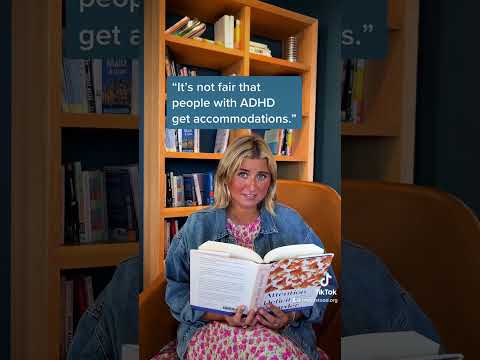
Friendly reminder: Misinformation around ADHD leads to harmful stigma, which prevents people from getting the support they need.
Follow us on Tiktok: A Instagram: Facebook: W Pinterest: e Facebook en Español: w Twitter: LinkedIn:
Understood is a nonprofit and social impact organization dedicated to shaping a world where the 1 in 5 people who learn and think differently can thrive.
NCMH research champion Laura discusses why she chose to take part in the Centre's mental health research.
ABOUT NCMH
The National Centre for Mental Health (NCMH) is working to find out more about what causes mental health problems such as depression, bipolar disorder, schizophrenia, ADHD and PTSD.
NCMH is made up of researchers from Cardiff, Swansea and Bangor Universities, and funded by Health and Care Research Wales.
We aim to improve life for people affected by mental health problems by supporting and undertaking mental health research, raising awareness of mental health issues and fighting stigma.
Together we can make a difference for mental health.
When LGBTQ youth experience rejection from their family and friends because of their sexual identity, they have an increase risk of depression, anxiety, suicide and substance abuse. The Trevor Project produces an annual survey of LGBTQ youth and their 2021 survey showed that 42% of LGBTQ youth seriously considered attempting suicide in the past year.
LGBTQ stands for lesbian, gay, bisexual, transgender, queer and questioning.
You as a parent or loved one, want to be an ally not an adversary. Here are 10 rejecting behaviors or things that you can say that increase your child’s risk of serious mental health problems. 1. Tell your LGBTQ child it’s just a phase 2. Allow family friends and relatives to talk negatively about LGBTQ around your child. 3. Tell your child to tone down how they look or act. 4. Prevent your child from having an LGBTQ friend. 5. Tell your child they need to get right with God or take them to religious leaders to have them pray to change your child. 6. Try to hit, slap or rough up your child to beat it out of them. 7. Prohibit your child from wearing things that express their gender diversity. 8. Not use the name or pronoun that matches your child’s gender identity. 9. Tell your child they can’t talk about that LGBTQ stuff around you. 10. Exclude your LGBTQ child from family events and activities
Here are 7 Examples of accepting behaviors that increase your child’s self-esteem and mental wellbeing. 1. Ask your child how and when you can help them tell others about their identity 2. Get accurate information to educate yourself about your child’s gender expression 3. Speak openly about your child’s LGBTQ expression 4. Require other family members to treat your child with respect 5. Use your child’s chosen name and the pronoun that matches their identity 6. Believe your child can be a happy adult and tell them they will have a good life. 7. Talk to your child about their identity and listen respectfully.
References Ryan C, Huebner D, Diaz RM, Sanchez J. Family rejection as a predictor of negative health outcomes in white and Latino lesbian, gay, and bisexual young adults. Pediatrics. 2009;123(1): 346-352. TheTrevorProject.org and FamilyProject.sfsu.edu
WANT TO START IN THERAPY? Here’s a convenient and affordable option
For a monthly fee, you get a REAL licensed therapist with whom you can meet weekly by phone, video or chat. You can also send daily messages. For a full review of the service, watch this video w
If you use this link you will get a 10% discount on your first month. This is an option I’ve researched. I get a referral commission if you sign up.
Want to know more about mental health and self-improvement? On this channel I discuss topics such as bipolar disorder, major depression, anxiety disorders, attention deficit disorder (ADHD), relationships and personal development/self-improvement. I upload weekly. If you don’t want to miss a video, click here to subscribe.
Disclaimer: All of the information on this channel is for educational purposes and not intended to be specific/personal medical advice from me to you. Watching the videos or getting answers to comments/question, does not establish a doctor-patient relationship. If you have your own doctor, perhaps these videos can help prepare you for your discussion with your doctor.
My personal experience with Concerta and ADHD after 15 years of daily use.
While scrolling through YouTube, I came across people who had shared their experiences with Ritalin and Concerta.
So I decided to share my personal experience with the medication with you.
Enjoy and please don't forget the comments section.
O’Neill is like most parents struggling to teach their kids at home during the pandemic. She didn’t realize at first that some of her frustration was due to an underlying condition in her youngest child.
O’Neill explains, “You can tell, the wheels have been turning, you can see the ideas coming in her head and it’s taking away from school work.”
O’Neill’s daughter was diagnosed with ADHD. Experts believe that the pandemic has exacerbated symptoms.
FULL STORY: 7
Get in touch with us via social media: Go 419 on Facebook – / Facebook – / Twitter: / Instagram – / WTOL 11 newsletter
Body dysmorphic disorder (BDD) is a brain disorder that creates faulty and inaccurate perceptions about your appearance. Some people can have delusional beliefs which make it appear that the flaws you see in your body are correct.
This is the criteria according to the Diagnostic and Statistic Manual of Mental Disorders 5th Edition.
Preoccupation with perceived flaws or defects in physical appearance.
Repetitive behaviors are performed in response to appearance concerns.
Preoccupation can cause distress or impairment in important functions such as social, occupational, and other areas.
Concerns about body fat and weight are not better explanations for preoccupations in individuals with eating disorders.
About 2% of people start experiencing this problem during childhood, adolescence or early adulthood. The head or face is the most common area of concern. Head concerns things such as insisting that your ears are too big or misaligned.
This video will discuss a case of body dysmorphic disorder and provide examples to illustrate the criteria.
Because of your obsession with having a body flaw and the rituals and behavior you engage in, body dysmorphic disorder can be grouped with obsessive compulsive disorders. The treatment of this disorder is similar as OCD. It involves a combination medication and cognitive behavior therapy.
Video on Social Anxiety
E
These are some resources that can be helpful.
Resources
Phillips KA. The broken mirror. New York: Oxford University Press; 2005.
Body Dysmorphic Foundation g
References
Barnhill, John, et.al. Clinical Cases of Obsessive-Compulsive Disorders and Related Disorders DSM-5(r). August 2013
Feusner JD., Hembacher E., Moller H., Moody TD. A disorder characterized by abnormalities in object visual processing. Psychol Med. 2011;41(11): 2385-2397.
You want to learn more about mental health, self-improvement and other topics? On this channel I discuss topics such as bipolar disorder, major depression, anxiety disorders, attention deficit disorder (ADHD), relationships and personal development/self-improvement. I upload weekly. Click here to subscribe if you don't wish to miss a video.
Disclaimer: The information contained on this channel is intended for education purposes only and does not constitute specific/personal medical advice. The videos and the answers to questions/comments do not create a doctor-patient relationship. These videos may be helpful for you if you are a patient of your own doctor.
Do you feel like you're more clumsy than average? If you have ADHD, or even Autism, then CONGRATULATIONS you are more clumsy than the average person! Welcome to the club!!! No shame here.
Long-established research reveals that the majority of ADHD poeple have trouble with balance and lack the same awareness of where their body is situated in the space around them. As compared to folks who aren't adhd or on the autism spectrum.
The term for that is Postural Sway . Postural sway is your ability to balance when you you're learning to ride a bike, or keep your balance on say, a moving subway car.
➡️➡️➡️ Read an entertaining article about Postural Sway here:
b
Want to help me with ADHD Is the New Black?
The best gift at this stage is a financial gift.
This Is Stacey Machelle asking. I do it all:
Research, planning, writing, editing…the easy stuff. And All the hard stuff for me-the social media posts, promotions, publishing. I do All that too. It' a full-Time job. One that at the moment does not support me and my fur children.
If you can, please become a partner on Patreon
↘️
/>
Or, if this video helped you, feel free to buy me a coffee. Coffee Is great for the late-night editing crunches I pull ti get these videos to the world on time
☕️☕️☕️
k
Attributions
▶️TikTok video
@savetimeshan
▶️Proprioception Sketch Images
Image: Sketchplanations
▶️Music and stock photos and videos
Creative Commons License via
Kinemaster
Canva
An overview of childhood Attention Deficit Disorder Hyperactivity (ADHD) and the non-stimulant treatment Intuniv (guanfacine). Learn more about Intuniv at l
Drugs.com is the most popular, comprehensive and up-to-date source of drug information online. Providing free, peer-reviewed, accurate and independent data on more than 24,000 prescription drugs, over-the-counter medicines & natural products. Find helpful tools, wallet size personal medication records, mobile applications and more.
This episode explains the science of motivation and drive. I explain how dopamine, which is a chemical that we all produce in our brains, drives our desire to achieve and pursue our goals as well as our ability to move and enjoy pleasure. How we can use specific behaviors, reward programs and dopamine-prolactin levels to maintain motivation and pleasure for the long term is what I discuss. I also talk about dopamine in ADHD, craving, addiction, and some amazing results regarding the specificity of drug effects that are purely based on belief.
#HubermanLab #Motivation #Neuroscience
We are grateful to our sponsors:
Athletic Greens -
Headspace -
Magic Spoon -
Our Patreon page
n
Supplements from Thorne
n
Link to study
/ Effects of expectation upon specificity of stimulant effects
Social:
Instagram - b
Twitter - b
Facebook - b
Website - m
Join the NeuralNet - k
Timestamps below.
00: 00: 00 Introduction
00: 04: 22 Announcement: Spanish Subtitles
00: 05: 06 Emotions, Addiction & Mindset
00: 06: 22 Motivation & Movement: The Dopamine Connection
00: 07: 29 A Double-Edged Dopamine Blade
00: 08: 56 Dopamine Fundamentals: Precursor to Adrenalin
00: 10: 15 The Reward Pathway: An Accelerator & A Brake
00: 12: 10 Motivation=Pleasure Plus Pain
00: 14: 14 The Dopamine Staircase: Food, Sex, Nicotine, Cocaine, Amphetamine
00: 16: 15 Subjective Control of Dopamine Release
00: 17: 40 Social Media and Video Games
00: 18: 15 Addiction & Dopamine: Progressively Diminishing Returns
00: 18: 48 Novelty, Sensation-Seeking & Anticipation
00: 20: 15 Craving: Part Pain, Part Pleasure & Pain Always Prevails
00: 23: 11 Desire Scales With Pain: The Yearning Function
00: 24: 43 The Croissant Craving Circuit
00: 25: 45 "Here and Now" Molecules: Serotonin, Bliss & Raphe Nucleus
00: 26: 26 In Your Skin Or Out In the World
00: 27: 25 Cannabinoids Lethargy & Forgetfulness
00: 28: 15 The Almond Meditation
00: 29: 30 Drugs That Shift Exteroception Versus Interoception
00: 30: 36 Emotional Balance, Active & Passive Manipulation
00: 32: 36 Procrastination: Leveraging Stress, Breathing, Caffeine, L-Tyrosine, Prescription Drugs
00: 37: 04 When Enough Is Never Enough; How Dopamine Undermines Itself
00: 38: 58 Dopamine-Prolactin Dynamics: Sex, Reproduction & Refractory Periods
00: 40: 30 The Coolidge Effect: Novelty-Induced Suppression of Prolactin
00: 42: 22 Vitamin B6, Zinc As Mild Prolactin Inhibitors
00: 43: 25 Schizophrenia, Dopamine Hyperactivity and Side Effects of Anti-Dopaminergic Drugs
00: 45: 08 Prolactin, Post-Satisfaction "Lows" & Extending the Arc of Dopamine
00: 48: 00 The Chemistry of "I Won, But Now What?"
00: 49: 00 Healthy Emotional Development: Child and Parent
00: 50: 03 Never Say "Maybe" (Reward Prediction Error)
00: 52: 02 Surprise!
00: 52: 59 Are You Suppressing Your Drive and Motivation By Working Too Late?
00: 54: 50 Disambiguating Pleasure and Drive: Dopamine Makes Us Anti-Lazy
00: 58: 00 Beta-Phenylethylamine (PEA), & Acetyl L-Carnitine
01: 00: 00 Attention Deficit Disorders, Cal Newport Books, Impulsivity & Obesity
01: 03: 55 Leveraging Dopamine Schedules
01: 05: 22 Subjective Control of Dopamine and Drug Effects: The "Adderall" Experiment
01: 09: 03 Caffeine May Protect Dopamine Neurons, Methamphetamine Kills Them
01: 10: 57 Nicotine: Dopamine, Possible Neuroprotection, Prolactin Increase
01: 11: 53 Gambling, Intermittent Reinforcement, & Persistent Goal Seeking (Bad and Good)
01: 14: 14 Intermittent Halting of Celebration; Enjoy Your Wins, But Not All of Them
01: 18: 38 A Story Example of Intermittent Reward to Maintain Long-Term Drive and Motivation
01: 21: 25 Corrections & Notes About Spanish Captions & Other Languages Soon
01: 24: 00 Synthesis & Framework, Zero-Cost Support & A Note About Sponsors
The Huberman Lab Podcast does not include Dr. Huberman's research and teaching roles at Stanford University School of Medicine. This podcast is not intended to replace medical advice. The Huberman Lab Podcast, its guests, and affiliates, assume no responsibility for the use of the information.